Municipal & wastewater
Municipal biosolids
Dewatered WWTP sludge / biosolids
Potential dried output / use
Dried biosolids for permitted use or disposal; lower transport mass
Screening: EPA Part 503; PFAS, metals and pathogen testing
Drying as a Service
Revalox funds, builds, owns and operates the drying plant inside your site. You pay against agreed output — throughput, moisture and performance — without putting the dryer on your balance sheet.
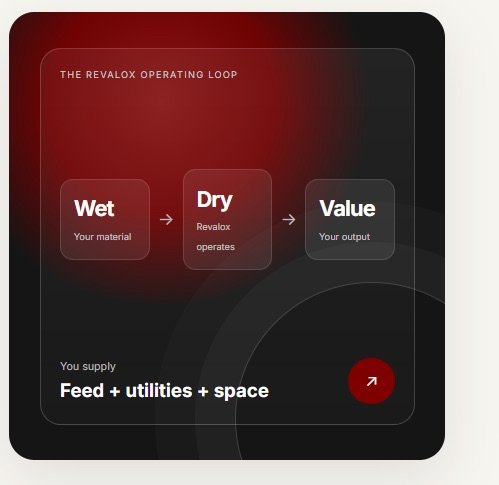
Show the commercial logic and the physical plant together in a single section. The operating-loop visual explains how wet feed becomes dried value, while the machine graphic shows the drying line Revalox funds, builds and operates on site.
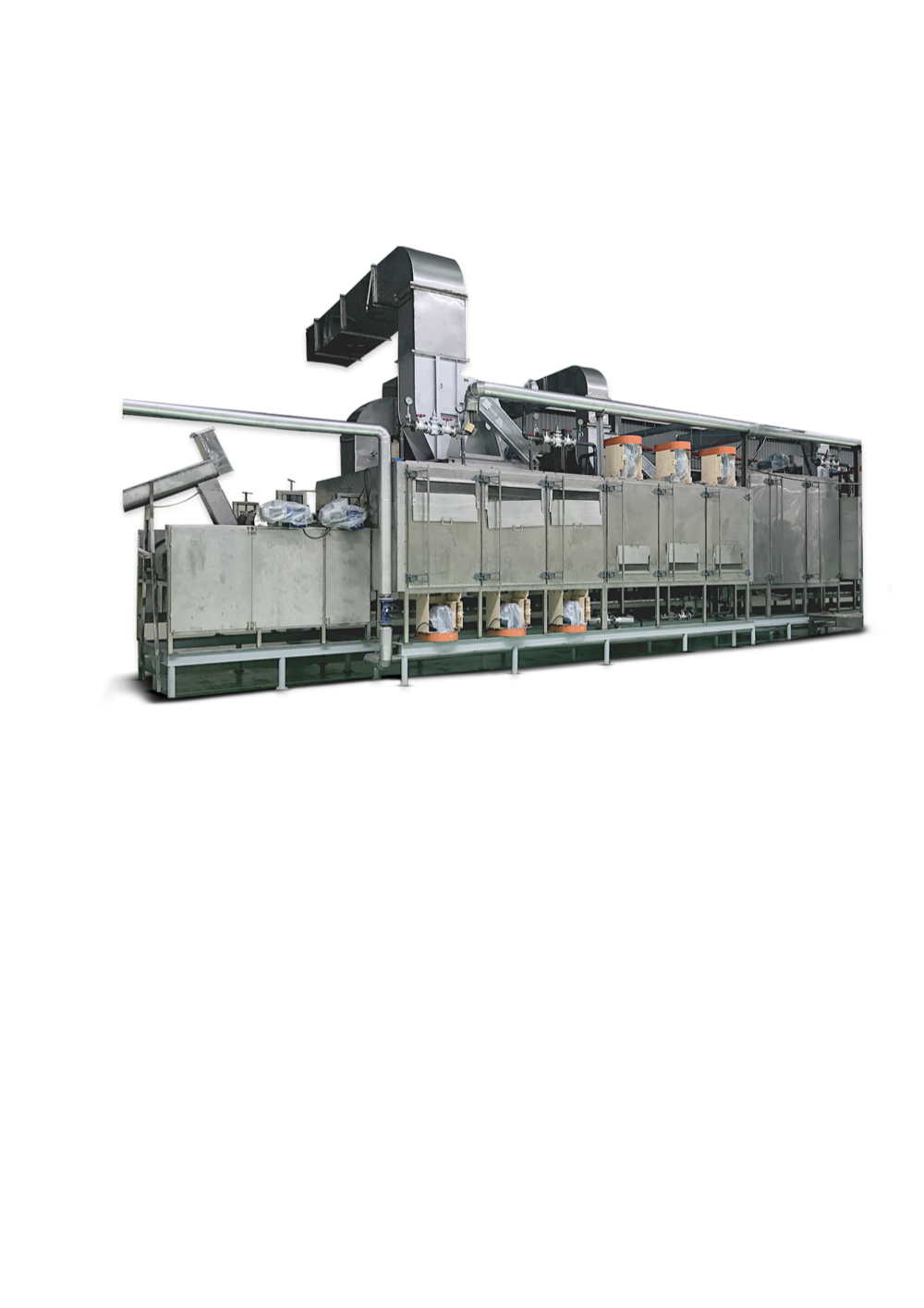
Under the Build–Own–Operate–Transfer (BOOT) model, Revalox develops and operates a purpose-built biosolids drying plant to your solids content, moisture target and throughput, with an agreed asset-transfer pathway. These are indicative engineering ranges:
Final specifications, performance guarantees, operating period and transfer conditions are determined by pilot trials, project engineering and the executed BOOT agreement.
Select a stream and drag the moisture slider. The model keeps dry solids constant and shows the change in mass and indicative value.
Illustrative commercial values only. Project economics are built from your sample, utility data, disposal contract and/or current selling price.
Revalox can serve both cost-centre streams and value-added product streams. The common denominator is moisture that is suppressing economics.
Reduce wet mass and convert difficult disposal into a more stable, transportable solid.
Create a handleable dry solid for compliant disposal, recovery or downstream processing.
Stabilise material for fertiliser, granulation, bagging or long-distance movement.
Dry to controlled quality for shelf life, ingredient markets and export-grade applications.
Convert short-life wet residues into stable feed ingredients and easier logistics.
Condition moisture for densification, pelletisation, thermal use or further valorisation.
Explore representative wet residual streams across US food, municipal, agro, manufacturing, biomass and recycling facilities. For each stream, identify the drying route and a potential value or disposal pathway.
Dewatered WWTP sludge / biosolids
Dried biosolids for permitted use or disposal; lower transport mass
Screening: EPA Part 503; PFAS, metals and pathogen testing
ETP sludge and mixed treatment solids
Reduced-volume dry cake for permitted disposal or qualified recovery
Screening: RCRA classification and local permits
Primary fiber sludge and biological solids
Fiber recovery where suitable; fuel or managed solids
Screening: Ash content, contamination, emissions
Dissolved-air-flotation float and grease solids
Managed dry solids; conditional organic recovery
Screening: Fats, odors, biological stability
Separated dairy manure / digestate
Bedding, compost input or soil product where allowed
Screening: Pathogens, nutrient management, state permits
Poultry manure and bedding
Nutrient product or fuel feedstock subject to approvals
Screening: Ammonia, pathogens, air emissions
Digester fiber and separated solids
Soil amendment / pelletized product where compliant
Screening: Nutrients, contaminants, local restrictions
Corn harvest residues
Biomass pellet / briquette feedstock
Screening: Particle size, fuel spec, fire protection
Rice milling and field residues
Biomass energy feedstock or industrial fiber
Screening: Silica, ash and handling
Sawmill and forest-industry residues
Pellets, briquettes, composite-board feedstock
Screening: Dust explosion controls and emissions
Corn ethanol wet distillers grain
DDGS / dried animal-feed ingredient
Screening: Feed quality, heat damage, FDA/state rules
Malted grain mash residue
Dried feed or ingredient if compliant
Screening: Microbial safety, food/feed specifications
Apple, grape, berry and citrus press cake
Fiber ingredient, feed, extraction substrate
Screening: Pesticide, allergen and food safety
Peels, pulp and processing scraps
Feed/ingredient powder or organics management
Screening: Product suitability and sanitation
Starch / potato-processing solids
Feed ingredient or downstream starch recovery
Screening: Drying temperature and sugar browning
Beet-sugar processing residue
Pelleted livestock feed
Screening: Feed specifications and moisture stability
Dairy by-products and concentrated whey
Powder ingredients with suitable spray/other process
Screening: Food safety, powder handling, process selection
Spent coffee from beverage production
Biomass/compost input; specialty extraction feedstock
Screening: Oil content, odor and market qualification
Fish / shrimp / shellfish by-products
Fish meal, ingredient or recovered solids
Screening: Hygiene, odors and approved process
Coconut husk, coir pith, shell and press cake
Coir growing media, biomass or feed by-product
Screening: Salt / tannins, food or feed suitability
Fiber fines, recovered pulp and screen rejects
Recovered fiber or conditioned energy feedstock
Screening: Plastics, ash and contaminants
Bark, shavings and chips
Biomass fuel or horticultural inputs
Screening: Ash, biological stability, fire risk
Non-hazardous process and filtration cake
Dried solids for recovery or permitted disposal
Screening: Hazardous-waste determination first
Kaolin, clay, calcium carbonate and mineral solids
Dry powder for industrial reuse where qualified
Screening: Dust, particle characteristics, end-use spec
Wet fertilizer and organic nutrient granules
Finished dry granules for packaging
Screening: Caking, thermal sensitivity, regulatory registration
Industrial gypsum / FGD material
Wallboard or other gypsum feedstock if qualified
Screening: Chemical impurities and product specs
Spent foundry sand and wet reclamation fines
Conditioned aggregate or foundry recovery feed
Screening: Metals, binder chemistry, state approval
Fly ash and bottom ash requiring conditioning
Construction material only if qualified
Screening: EPA CCR beneficial-use criteria; state rules
Wastewater treatment filter cake
Lower-mass waste for lawful disposal
Screening: Potential metals, dyes, hazardous classification
Non-hazardous API or intermediate filter solids
Recovery preparation or permitted disposal
Screening: Solvents, dust toxicity, GMP / RCRA review
Sorted residual solid waste fractions
Drier engineered fuel feedstock where permitted
Screening: Emission permits, composition, offtake
Wet char / pyrolysis fines
Conditioned material for qualified reuse
Screening: Combustibility, contaminants, market specs
Recovered fiber slurry and paper recyclate
Dry fiber or handling-ready feedstock
Screening: Polymer/ink residues and end-use testing
Wet, potentially hazardous process residue
Case-specific recovery or regulated disposal feed
Screening: High-hazard material: specialist review required
No streams match your search. Try a broader keyword or select all industries.
Screen RCRA hazardous-waste status, EPA air and water requirements, state and local permits, wastewater and stormwater controls, OSHA combustible-dust/process safety requirements, and any applicable FDA/USDA food or feed specifications. Biosolids land application requires applicable 40 CFR Part 503 and state compliance; coal combustion residual reuse is subject to EPA beneficial-use criteria and applicable state requirements. A dry output is not automatically an approved fertilizer, feed, fuel or commodity.
DaaS is the default, but the structure can match your balance sheet, your site capability and the market for the dried output.
Revalox owns and operates the plant on your site. You pay against contracted output.
Shared capital and shared margin for proven, dependable feedstock volumes.
For idle or underperforming assets where output and uptime matter more than ownership.
Revalox develops, finances (as agreed), owns and operates a purpose-built drying plant during the contracted term, with an agreed pathway to transfer the asset to the customer.
Built for US industrial facilities seeking outsourced drying capacity today and an option to assume ownership later.
Characterize feedstock, pilot-test it, secure site and utility scope, design the drying line, and complete construction and acceptance testing.
Revalox or a project entity owns the contracted plant. Funding, land/site rights, insurance and financing terms are negotiated project by project.
Operate and maintain the plant against agreed KPIs: input tonnage, discharge moisture, availability, energy use and product quality.
Transfer the plant at the contracted milestone subject to buyout/transfer pricing, asset condition, training, documentation and handover tests.
Revalox is built on industrial drying engineering from Gem Drytech Systems and Beltotherm® technology, with the operating model wrapped around proven process equipment.
Sample, daily tonnage, moisture and current disposal or sale economics.
Test actual material and establish the achievable outlet specification.
Mass balance, energy, service fee, output value and risk allocation.
Fabrication, commissioning, operating crew and performance reporting.
Share the material, tonnes per day, inlet moisture and your current disposal cost or sale price. We will turn it into a drying service model.
General & project enquiries: info@revalox.com
Direct line: sg@gemdryers.com